
A Short Personal History of Livingston’s Creative Activism
Creative Activism seems like an appropriate term to describe the multi-faceted, and complex approach, to work to win important environmental victories, when issues threaten what’s best about our communities.
Creative Activism is radical in the sense that one uses imagination, while working in small groups, to think of approaches to problem solving, involving community activism. What Livingston thinks is radical about the idea of Creative Activism, is that it uses the same thinking and creative processes as art making, that when put into action, result in slightly different approaches to running a media campaign on an issue. Often slight differences result in big successes over time.
Two local examples of major wins from the last decade, that stopped inappropriate developments, used legal action. These court cases were against oil and gas drilling and fracking here in Western Cape Breton Island, and the Cabot Golf course condo development at Inverness beach. These legal actions made potential investors insecure about these projects. In the first case Petroworth’s stock price headed to almost zero, and in the other people declined to invest in condos, where the historic land title was being challenged.
While court action is expensive, time consuming, these actions still have resulted in wins by stopping the planned projects, even though the court cases challenging these developments were lost.
Winning is important on important community issues, but also is hard work and time consuming. This volunteer work can be dynamic and exciting, especially if using creative thinking and a creative approach.
At some point in his career making films on environmental issues within his community of Cape Breton, and also being an activist directly on issues, Livingston developed a creative approach to attracting media and running media campaigns on environmental issues, which he calls Creative Activism.
The origin of this approach came from being involved in a very long battle, working with Elizabeth May and others, in the 1970s, which stopped chemicals being sprayed on our forests, and us, in Cape Breton. See Neal Livingston’s films: Budworks and Herbicide Trials.
Budworks (1978) documents the horrific spraying of millions of acres of forest annually in New Brunswick with the herbicide Fenitrothion, and how 21-year-old Elizabeth May, who eventually became the leader of the Green Party of Canada, and a member of parliament, stopped the spraying of millions of acres of forests in Nova Scotia.
Herbicide Trials (1984) documents an important Canadian court case, which climaxed a campaign to stop the spraying of Agent Orange, a carcinogenic mixture of 24-D and 245-T, on the Crown lands of Cape Breton leased by the Swedish multinational Stora Kopparberg, the worlds oldest incorporated company. Stora’s pulp and paper factory was the largest employer in southern Cape Breton Island. The massive environmental effort was coordinated by Elizabeth May and involved activists from throughout Nova Scotia. The legal case pitted 12 Cape Breton rural residents against Stora. Unfortunately, they lost the court battle, and the plaintiffs, exhausted by the 2 ½ years of litigation, abandoned an appeal.
Despite the loss of the Nova Scotia Herbicide Court Case, the continued efforts of activists eventually resulted, by 1990, in ending spraying of forests that was taking place in Cape Breton, while the mainland of Nova Scotia to this date still suffers this corporate plague.
Alongside making political documentaries on environmental issues, in the 1980s Livingston became more direct in his activism on issues and campaigns to stop spraying and clearcutting, and to promote wilderness protection. He volunteered with The Margaree Environmental Association (MEA), and Citizens Against Pesticides (CAP) using media releases, poster campaigns, and commercial billboards. In addition, their core group of activists initiated smaller court cases against the issuing of the permits to spray, all of which were lost. These efforts did succeed in building public awareness of environmental issues, and raising their profile with decision-makers in government and industry.


Never before had Nova Scotia seen rural dwellers become skilled activists and repeatedly take on the government, to challenge the historic status quo and old boys networks. Many of them had moved to Nova Scotia to live in rural areas. They were well educated, and not about to be told to stay at home and mind their own business within the confines of our farms; aka – “Shut up”, which seemed to be the historic norm in rural Nova Scotia.
In the years following the loss of the Herbicide Trials case, a number of the group who were active on forestry and spray issues, organized and continued fighting to stop the spraying of pesticides and herbicides on forests and nearby homes.
Jim and Sue Watkins, along with Maria Coady and Brian Peters were pivotal in starting the Margaree Environmental Association, an organization initially dedicated to support fundraising for the Herbicide Court case 1982-4. The MEA became over the next four decades the largest and most active environmental organization on Cape Breton.
In the 1990s, the Margaree Environmental Association, of which Livingston has been a long-time Co-Chair with Brian Peters, ran the first billboard campaign, along with posters, to protect old growth forests which were being massively clearcut on the Keppoch Plateau near Lake Ainslie, Cape Breton. The government response was to fly journalists around the area, after which the journlaists all agreed with the group, and soon after this tour the cutting of this area mostly ceased.
Part of their campaign involved Livingston producing a short film, The Cape Breton Endangered Spaces which included aerial footage, with a narration of the story of extensive old growth forests being clearcut and sprayed.
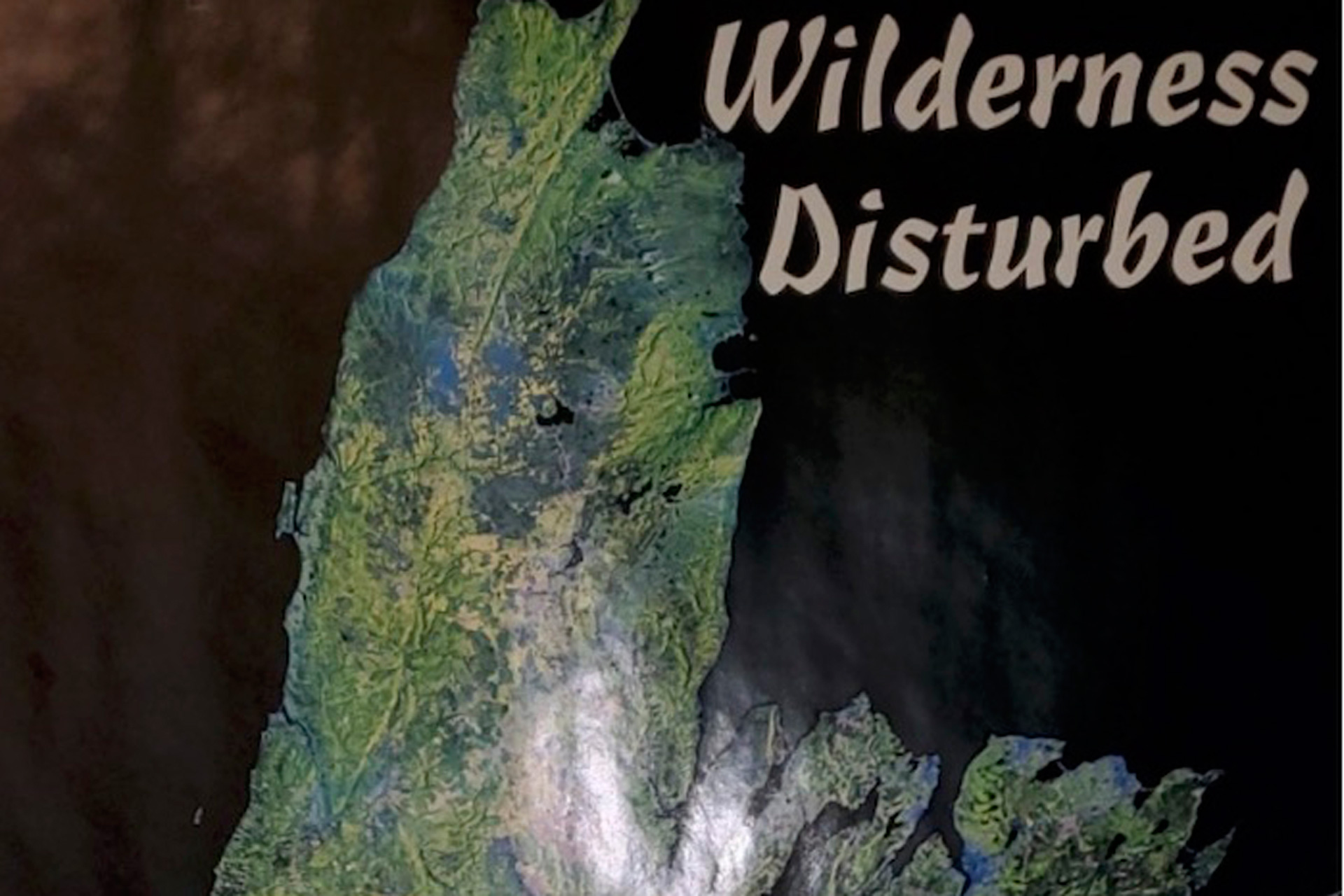
Next, they ran a successful traveling photo exhibit, with photographs done by Stephen Patterson, to show the beautiful remaining old growth forests on Cape Breton Island, together with a poster campaign, which used early satellite imaging to highlight extensive clearcuts, and to demonstrate the ubiquity of clear cutting of old growth hardwood forests.
Thereafter, more successful actions by the Margaree Environmental Association, and others, resulted in significant areas of Nova Scotia becoming protected as wilderness, after years of the government saying there was nothing to protect.
From the early 1980s, the MEA was part of a very active Cape Breton anti-spray coalition called CAP – Coalition for Alternatives to Pesticides, first chaired by Brian Peters and then by Charly Restino. Frequently they used the court room in Baddeck for their meetings, so whoever chaired the meeting that day (Livingston did at least once) would sit up in the judge’s chair, and even use the gavel to control the meetings.
As much as he can remember, regular attendees were Jim and Sue Watkins, Brian Peters, Charles and Suzy Restino, Candace and Peter Christiano, Aaron and Ruth Schneider, Burland Murphy, Dr. Jim O’Brien, Maria Coady, Geoffrey May, Chris and Judy King, Lloyd Stone, Otis Tomas, Judy and Sam Brooks, among others.
About Elizabeth May
Elizabeth May (born 1954) is a formidable force in Canadian politics and environmental law, known for a career that seamlessly blends grassroots activism with high-level policy negotiation. After moving from Connecticut to Nova Scotia in the 1970s, she rose to prominence leading local battles against pesticide spraying before earning her law degree from Dalhousie University. Her influence reached the federal level in the mid-1980s when she served as a senior advisor to the Environment Minister, playing a pivotal role in the creation of national parks and the landmark Montreal Protocol. Before entering partisan politics, May spent nearly two decades as the Executive Director of the Sierra Club of Canada, where she established herself as one of the country’s most relentless advocates for ecological preservation.
In 2006, May transitioned to electoral politics by winning the leadership of the Green Party of Canada, eventually making history in 2011 as the first Green MP elected to the House of Commons for Saanich—Gulf Islands. Renowned for her encyclopedic grasp of parliamentary procedure—often used to keep the government on its toes—she has been repeatedly honored by her peers as “Parliamentarian of the Year” for her work ethic and oratorical skill. Though she briefly stepped aside in 2019, she returned to lead the party again in late 2022 to provide stability. As of 2026, May remains a singular and resilient fixture in Ottawa, continuing to champion climate justice and electoral reform as one of the most experienced and respected voices in the House of Commons.