
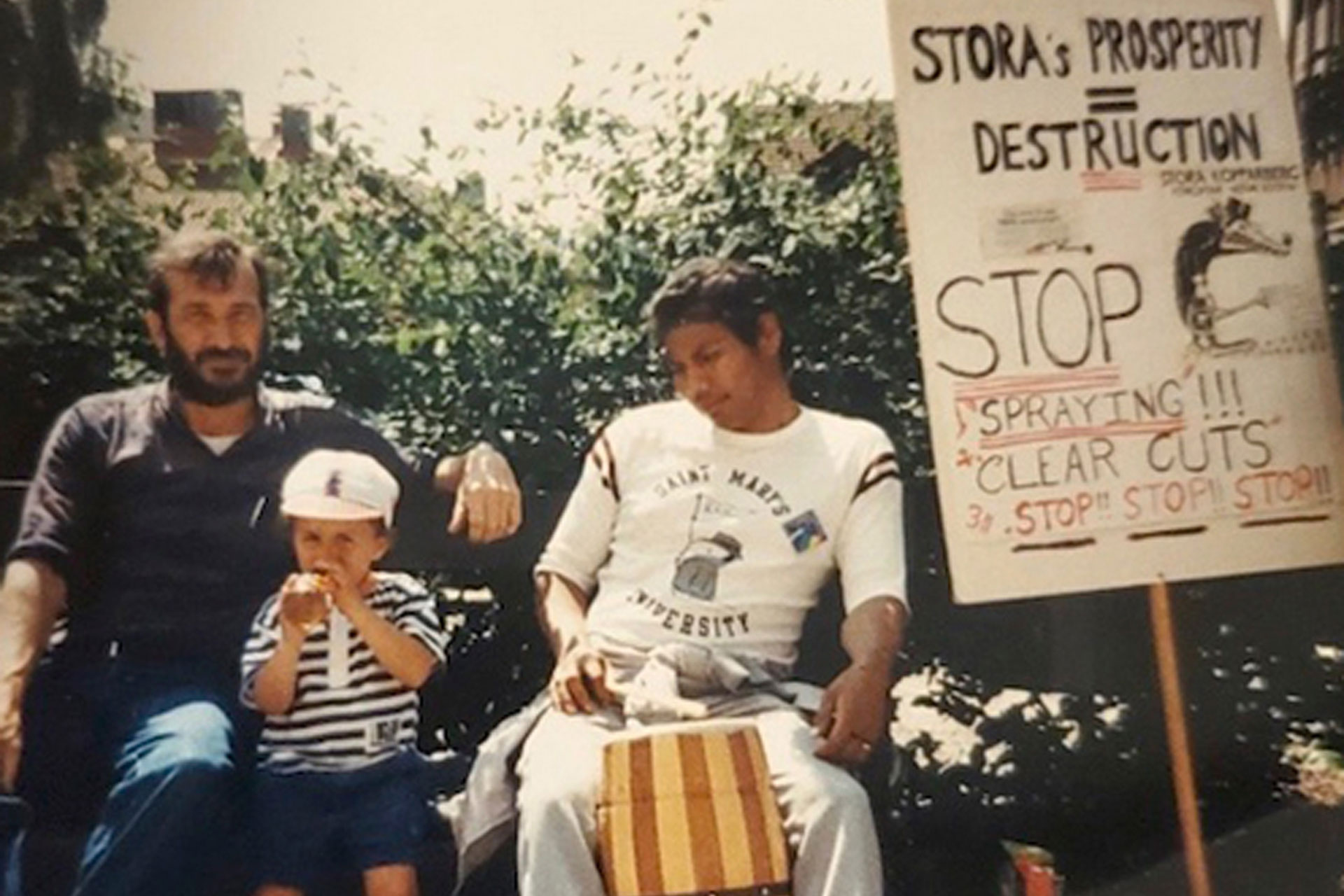
In the spring of 1989, Neal Livingston developed the idea that a delegation, consisting of Charles Restino, his local First Nations colleague Charles “Junior” Bernard, his partner Diane Moore, their 4 year old son Geoffrey, and himself, would fly to Sweden to attend Stora Kopparberg’s multi-million dollar 700th birthday party. The intention was to protest and build awareness in Sweden of the herbicide spraying and forest clearcutting being conducted in Nova Scotia, by the parent company of our local pulp and paper mill. He conceived of the protest like a theatre play; that the 5 of them would simply appear wherever the events were taking place, to protest over several days, and hold press conferences.
Elizabeth May in 1984 has led a similar entourage to Sweden to pressure Stora to cancel the proposed herbicide spraying. The Swedish Prime Minister condemned forest spraying, which was not allowed in Sweden, and they attracted a huge amount of Swedish media attention. To note; Quebec and Ontario do not allow forest spraying, while New Brunswick has permitted massive spraying of millions of acres for years whether on Crown lands or private lands, the majority of which are Irving owned or leased by Irving on New Brunswick’s Crown land.
When they arrived in Sweden, the environmental groups hosting them had already briefed the media of their arrival and purpose of their visit. Well, what attention they garnered! Stora has over 100 divisions of the parent company worldwide and this group was comprised of the only people protesting! The media from all over Sweden, Scandinavia, Europe, and even Canada were there. As Livingston had hoped and imagined, the media had nothing else to cover except the big party, and his group. They became front page news, and radio and TV stars over the next 4 days. Even the police were excited to meet the group, as was the general population, as they moved around the town of Falun, Stora’s home town.
Through the group’s protests, they were demanding an end to spraying and clearcutting. They requested a meeting with Stora’s President, and left with little choice, he had them meet with his entire Board of Directors. Livingston recently spoke with Charles Restino on March 25, 2020; he now lives in Victoria, British Columbia. Charles reminded Livingston that it was this meeting that sealed the end to Stora spraying herbicides in Eastern Nova Scotia in 1990. At that time, Stora’s forest operations in Nova Scotia covered more than a million acres of Crown and private land.


About Elizabeth May
Elizabeth May (born 1954) is a formidable force in Canadian politics and environmental law, known for a career that seamlessly blends grassroots activism with high-level policy negotiation. After moving from Connecticut to Nova Scotia in the 1970s, she rose to prominence leading local battles against pesticide spraying before earning her law degree from Dalhousie University. Her influence reached the federal level in the mid-1980s when she served as a senior advisor to the Environment Minister, playing a pivotal role in the creation of national parks and the landmark Montreal Protocol. Before entering partisan politics, May spent nearly two decades as the Executive Director of the Sierra Club of Canada, where she established herself as one of the country’s most relentless advocates for ecological preservation.
In 2006, May transitioned to electoral politics by winning the leadership of the Green Party of Canada, eventually making history in 2011 as the first Green MP elected to the House of Commons for Saanich—Gulf Islands. Renowned for her encyclopedic grasp of parliamentary procedure—often used to keep the government on its toes—she has been repeatedly honored by her peers as “Parliamentarian of the Year” for her work ethic and oratorical skill. Though she briefly stepped aside in 2019, she returned to lead the party again in late 2022 to provide stability. As of 2026, May remains a singular and resilient fixture in Ottawa, continuing to champion climate justice and electoral reform as one of the most experienced and respected voices in the House of Commons.