
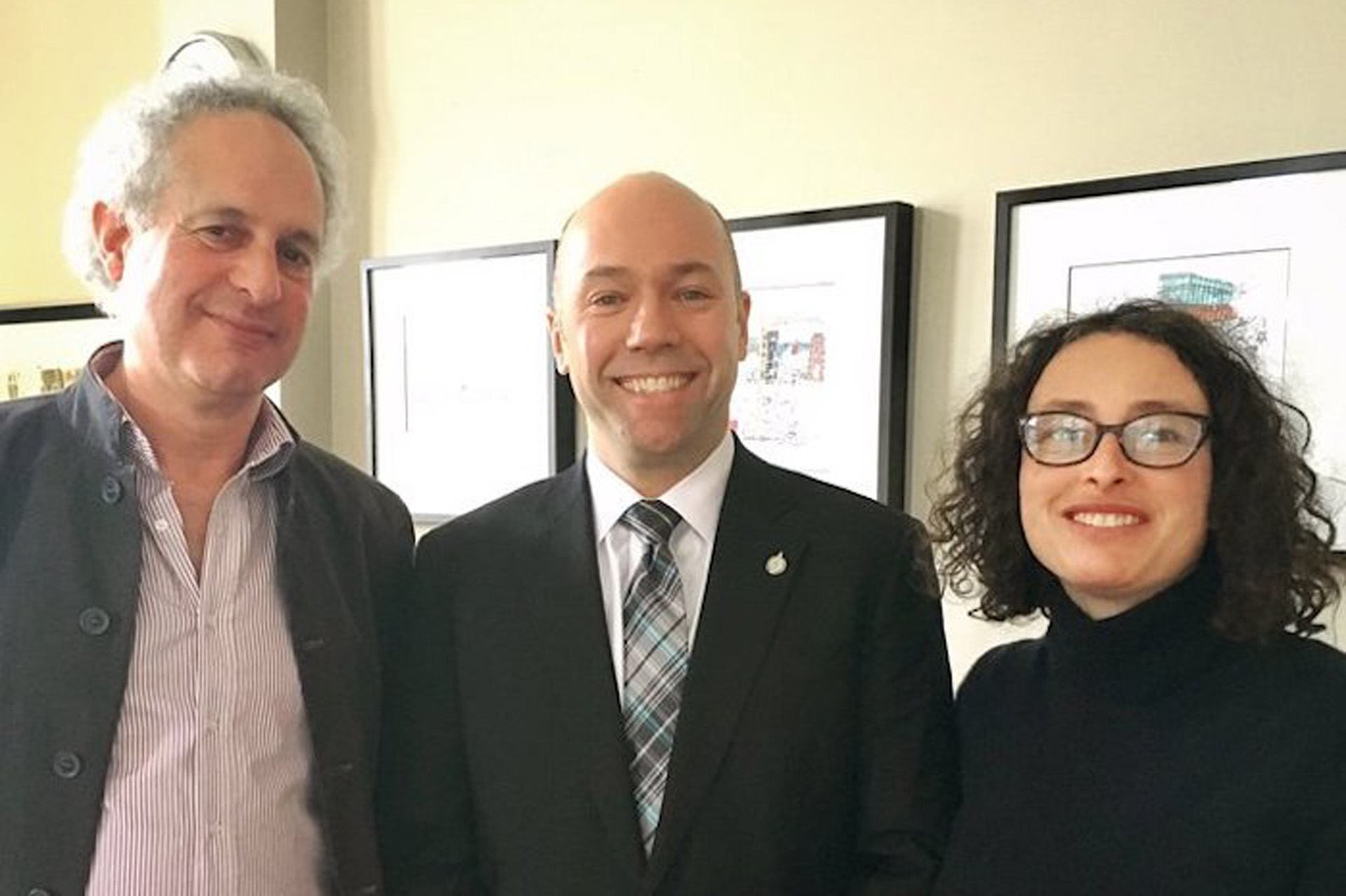
Geoffrey Livingston (left), MP Andy Filmore (middle), and Gretchen Fitzgerald (right) in Ottawa, April 10, 2017.
The most important issue in need of resolution is to end coal burning in Nova Scotia for electricity. Nova Scotia has gained an exemption from the Federal government, to allow Nova Scotia Power to burn coal for electricity, originally until 2030, but now extended in 2019 to 2040.
Nova Scotia Power, a private Emera-owned company, has a monopoly to provide power in Nova Scotia. It is still allowed by Nova Scotia and the Federal Government to burn coal for at least 50% of its power generation, making it one of the worst polluters in Canada.
The Clean Power Now Campaign
In 2011, prior to the Muskrat Falls construction, Peggy Cameron, Gretchen Fitzgerald of Sierra Club of Canada, and Neal Livingston, noticed that Quebec Hydro had signed a long-term deal with Vermont to sell power at 5 cents per kwh, so we decided that they wanted a similar deal for Nova Scotia.
Neal called the Premier’s office in Quebec, who forwarded him to the Environment Minister’s office, who connected him to the Executive Assistant (EA) for the Minister. Amazing, he knew all about the capacity of Quebec power that could be be moved across New Brunswick, as Hydro Quebec almost bought New Brunswick Power a few years before. The EA informed Livingston that 300MW would be very doable on existing power lines in New Brunswick.
They were then able to calculate that moving the power through New Brunswick under existing tariff rules, where the lines could be booked for 300mw, would add about 1 cent per kwh to the price from Quebec. Nova Scotia Power could make a few cents on distributing the power, and the total price for power in Nova Scotia to all classes of ratepayers would be no more than what we pay now; a long-term win / win / win for all parties, including the public.
So, they had found a once-in-a-lifetime solution to reduce coal power by 40% right away in Nova Scotia, and at the right price. They organized a press conference, one of several they held over the next 3 years, launched a campaign called Clean Power Now, and demanded that the government and the utility take action. Luckily, they received national and local media attention.
Read More
Eventually, the massively over budget and very delayed Muskrat Falls hydro plant will provide 3000MW to Nova Scotia, and with 300MW from Quebec, 85% of Nova Scotia’s coal burning could be turned off.
When the Trudeau government took power in 2015, the group contacted the Environment and Natural Resources departments, travelled to Ottawa to meet with Ministerial advisors in 2016 and 2017, and demanded that Ottawa bring all the relevant parties together to get the 300MW moving to Nova Scotia. Ottawa, by doing nothing declined to act, while Environment Minister McKenna extended the date for Nova Scotia to be off coal burning for electricity an extra 10 years from 2030 to 2040.
Through 2018 and 2019, they held more press conferences, wrote the politicians, met with Nova Scotia departmental personnel, met again with Nova Scotia Power executives, and no one wanted to act. They met with Hydro Quebec, and senior staff in the New Brunswick government, who like Quebec, confirmed that 300MW of space could be booked. The group demanded the Province of Nova Scotia do this, and demanded the same of Nova Scotia Power.
In autumn 2019, the Premiers of Eastern Canada, including Quebec, said they would continue to discuss Quebec power coming to the Maritimes. As well, they commissioned a study to look at 800MW from Quebec for New Brunswick and Nova Scotia.
In March 2020, Livingston followed up their December 2019 meeting with Nova Scotia Power President Wayne O’Connor. He surprised Neal by telling him that plans were moving forward on Quebec power for Nova Scotia, and that NS Power was already receiving 50MW of power this winter. He said that Nova Scotia Power, New Brunswick Power, and Hydro Quebec were now working together on plans for both New Brunswick and Nova Scotia to be using 800MW of power from Quebec, which requires new transmission lines. Livingston encouraged him to not wait for these transmission line upgrades, but to move forward with a contract to use 300MW now from Hydro Quebec. Nova Scotia Power President O’Connor also told Neal during their call that the Premier of Nova Scotia had offered to meet with any officials necessary in Quebec, New Brunswick, and Ottawa, to help move forward with this transition to get off coal and to use existing hydro power from Quebec.
So, it looks like the group will have a win coming over the next couple of years, or 5 years at the most, to get Nova Scotia off of burning most of its coal, and dirty wood fired biomass, instead of 2030-2040. Neal is not sure if their almost 10 years of volunteer work will ever be recognized on this, but their goal to get Nova Scotia off coal burning sooner versus later will be realized. And to note, power from Quebec will not impede the development of more renewables in Nova Scotia and New Brunswick.
As a final note, Neal Livingston encourages everyone who can, to put grid interconnected solar on their homes as soon as possible. It will give you energy security and a stable cost of energy for years to come, with a pay back in less than 10 years. Once you have energy security you will find you have a lot more time for creative activities, which Neal hopes will include Creative Activism.